
Level 1
5 lessons
Qubits & Gates
Beginner
The foundations: qubits and states, single-qubit gates, measurement, superposition, and entanglement.
See It Live
Every lesson ships with its own interactive lab. Steer a qubit, watch the Bloch sphere respond in real time, and run real measurement shots to see how randomness converges to theory.
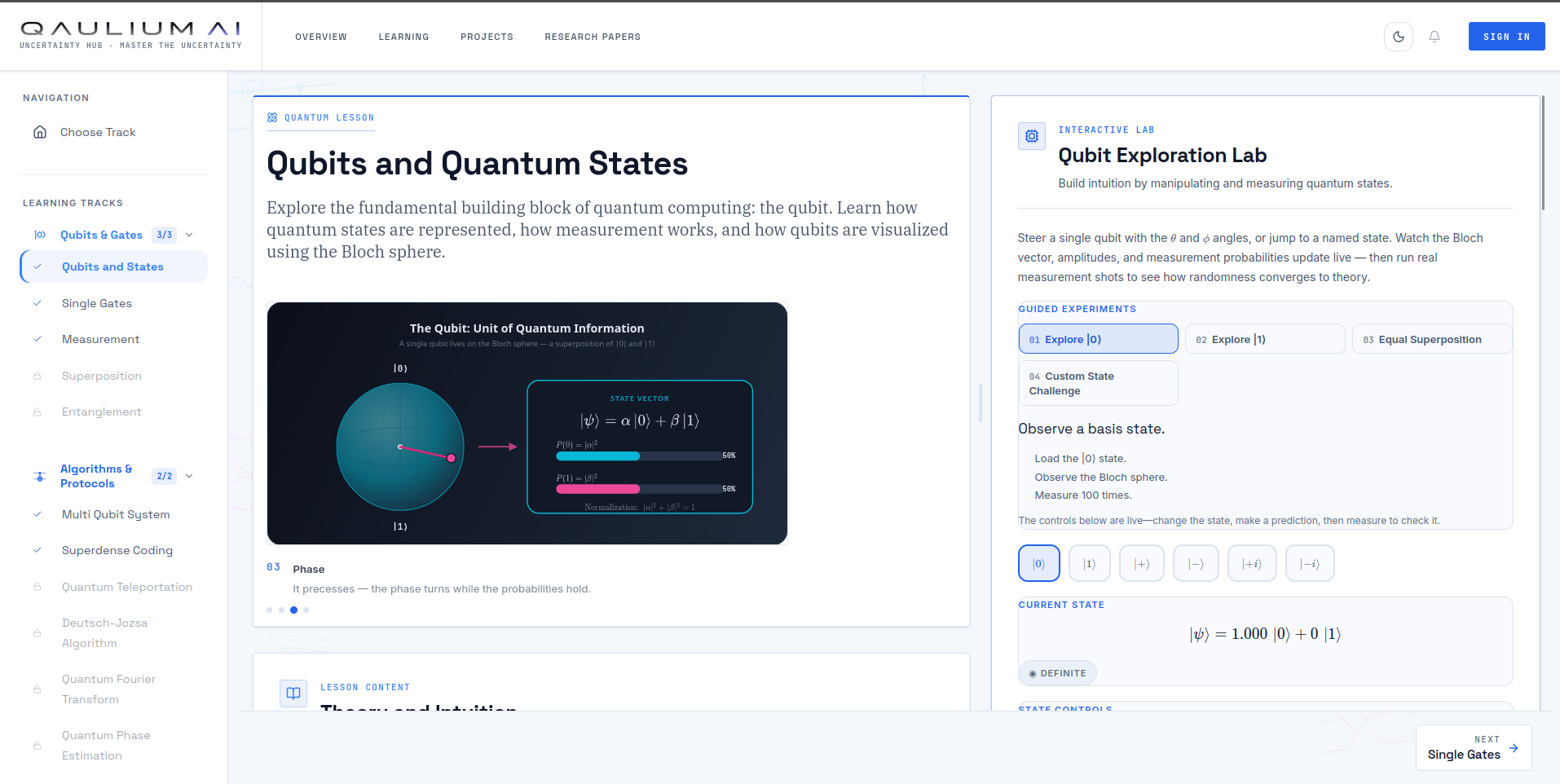
The Qubit Exploration Lab — live in the Qubits & States lesson.
Curriculum
Learning is organized into 4 levels, ordered so nothing depends on something you haven't met yet. Each lesson walks through the same rhythm: intuition → the mathematics → an interactive simulation you can play with → a quiz to check it landed.
Beginner
The foundations: qubits and states, single-qubit gates, measurement, superposition, and entanglement.
Intermediate
Multi-qubit systems, superdense coding, quantum teleportation, the Deutsch–Jozsa algorithm, the Quantum Fourier Transform, phase estimation, Grover's search, VQE, noise models, and quantum error correction.
Advanced
Shor's factoring algorithm, Hamiltonian simulation, QAOA, quantum walks, and surface codes.
Research
Open problems, each with a research-grade studio you can actually run: variational quantum algorithms, quantum machine learning, topological quantum computing, quantum chemistry, fault-tolerant quantum computing, and quantum networking.
The Lab
Build quantum circuits by dragging and dropping gates. The state vector, measurement probabilities, and per-qubit Bloch-sphere views update instantly on every change, and you can export the equivalent real code with one click.
A code editor that runs real quantum Python — Qiskit, PennyLane, Cirq — on the server and returns genuine output, error messages, and plotted figures, just like a real installation. Requires sign-in.
Every topic has its own custom-built interactive simulation designed for that concept alone — Bloch spheres, probability graphs, Grover amplitude views, and more.
A block-based workspace that mixes writing, math, runnable code, and circuit diagrams, so your reasoning stays attached to your experiments.
A curated papers section tied to the research studios and projects — read the source, then run it.
Guided Projects
24 hands-on projects across 4 levels, each one a guided reproduction of a real, published result. Every project opens a workspace containing an interactive lab, a step-by-step code track, the measurements, and the actual paper it reproduces — so you can compare your result against the one that got published.
Runs on real frameworks, not toy approximations
Research Papers
Every research studio and guided project is tied to the real paper it comes from, curated inside the platform so the source and the simulation sit side by side.